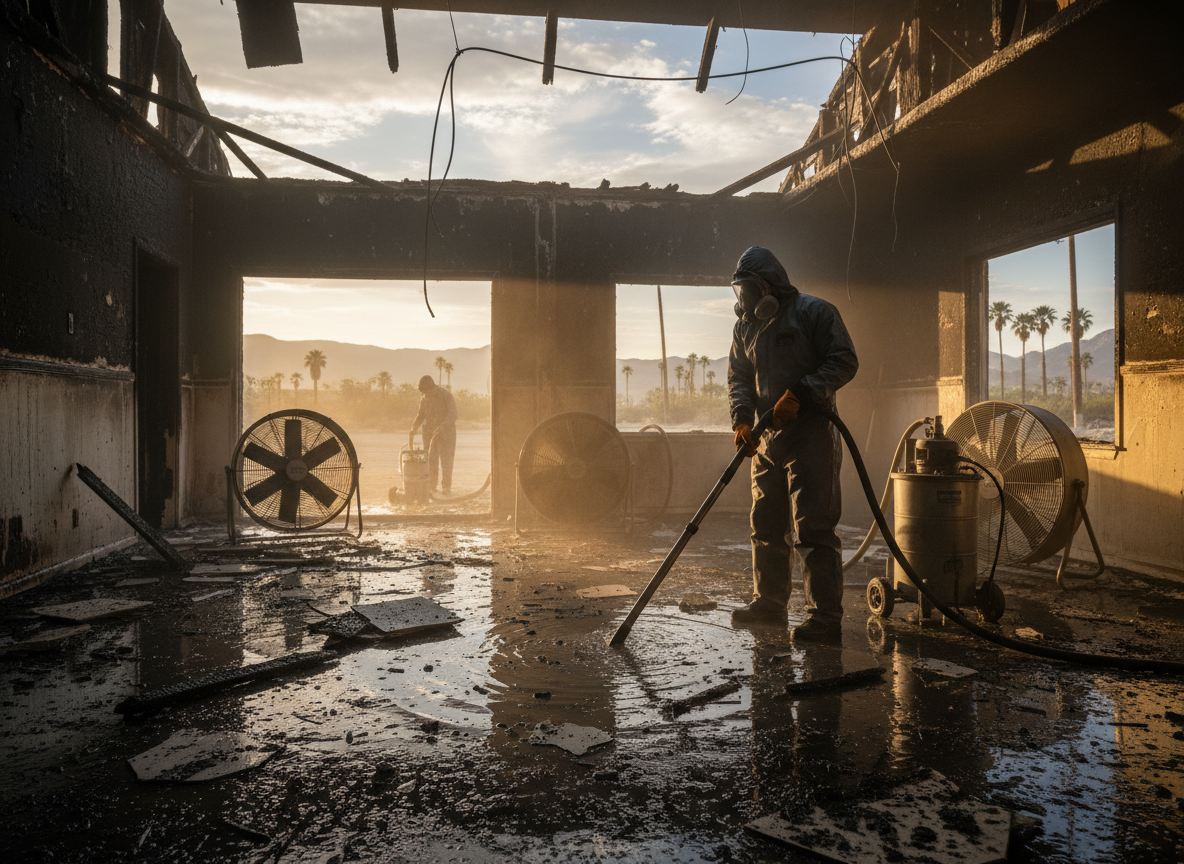
Firefighting water in Thousand Palms often soaks into stucco and slab foundations common in 1960s-1980s tract homes along Ramon Road and near the Coachella Valley Preserve. The region's extreme heat then drives rapid evaporation that leaves mineral deposits and hidden moisture pockets under tile or carpet. Without extraction within hours, secondary mold growth starts in wall cavities where airflow is limited by single-pane windows typical of older Palm Desert-adjacent properties.
Smoke residues bond differently on porous drywall versus concrete block in this dry climate, requiring separate pH testing and HEPA air scrubbing before any drying equipment is placed. Riverside County building codes for fire-damaged structures demand documentation of moisture levels below 15 percent before walls can be closed, a step that changes timelines when summer temperatures push equipment performance. Homeowners near Thousand Palms often discover water has migrated into HVAC ducts routed through attics, creating hidden odor sources that standard fans miss.
We map affected zones room by room using thermal imaging calibrated for desert diurnal swings, then remove saturated insulation without disturbing remaining soot layers that could re-contaminate cleaned surfaces. Final clearance includes verification that subfloor moisture matches pre-loss readings, preventing cupping in hardwood floors found in some custom homes bordering the preserve.
Hidden Moisture Paths in Desert Construction
Concrete slabs in Thousand Palms homes frequently channel water toward garage stem walls after fire suppression, a pattern missed by surface-only drying. ## Post-Fire Sequence Initial water removal must precede odor neutralization because residual moisture reactivates smoke particles during the hot afternoons common here.
Technician insight
In Thousand Palms, the thing that catches most people out with water damage remediation after fire is how fast the hot desert air pulls surface moisture out while leaving pockets trapped under the slab edges of 1970s homes near the preserve; skipping thermal scans on those first visits means callbacks weeks later when odors return.
Fire suppression water in a Ramon Road home
Suppression lines from a kitchen fire sent water under the slab and into perimeter walls of a 1978 Thousand Palms house. Thermal imaging showed moisture had traveled 12 feet toward the garage stem wall. We extracted, dried the cavities over four days, and verified levels matched the surrounding dry desert soil before closing the walls.
How it works
- 1
Site Assessment
Walk every room with moisture meters and thermal cameras to trace water from suppression lines through slab edges and wall cavities typical in local tract construction.
- 2
Water Extraction
Remove standing water and pull saturated carpet pad before desert heat locks minerals into flooring.
- 3
Drying and Monitoring
Place air movers and dehumidifiers, checking readings daily until levels match surrounding dry desert conditions.
- 4
Sanitization and Clearance
Apply antimicrobial treatment to affected materials and document moisture readings for any required county inspection.
Pricing
Cost depends on square footage affected, depth of water into slabs, and whether HVAC ducts require cleaning; we provide an upfront assessment before work begins.